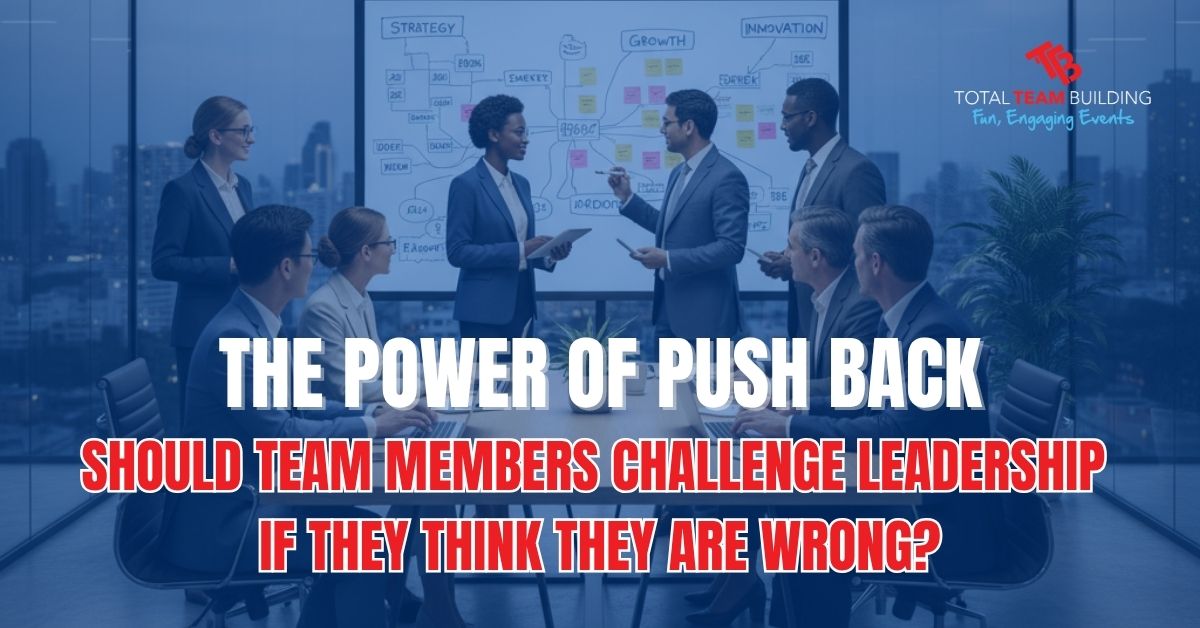
Should Team Members Challenge Leadership If They Think They Are Wrong?

Disagreement inevitably surfaces when more than a few people gather on a team. Different backgrounds, experiences, and viewpoints naturally collide. What happens when team members disagree with a decision made by their leader? Should they speak up and challenge the direction, or simply stay quiet and follow along?
Navigating conflict is a core component of team building. When handled correctly, pushing back against a leader’s opinion can transform a good team into a great one. We will explore how open disagreement shapes effective leadership, improves workplace collaboration, and leads to better outcomes for everyone involved.
Team Decision Making

The Anatomy of Team Decision-Making

Group choices are inherently more complex than individual ones. When a single person makes a choice, they only consult their own expertise. When a group tackles a problem, multiple perspectives enter the mix.
For team decision-making to thrive, the leader must create an environment that welcomes diverse thoughts. The most effective managers guide their teams through complex choices by adopting a few key behaviors:
  • Asking for genuine input from all team members
  • Listening closely to alternative suggestions without immediate judgment
  • Considering all viable options, rather than stubbornly clinging to their original idea
  • Communicating transparently about why one path is ultimately more favorable than the others
If a leader ignores these steps, challenging a decision becomes incredibly difficult. Team members often feel marginalised or ignored. However, when leaders actively invite feedback, respectful challenges spark deeper conversations and uncover hidden risks.

Inclusive Team Building

Why Employees Need to Voice Disagreement

Employees will often see things differently from management. Those working closely with the daily operations often spot flaws that high-level strategy overlooks. At least a few team members will likely feel dissatisfied with a leader’s proposed direction, especially on major issues affecting the entire organisation.
Disagreement is not inherently negative. In fact, controversy over the choices placed in front of a team often drives innovation. Data consistently indicates that teams with high psychological safety, where members feel secure taking interpersonal risks, outperform their peers. When people feel safe voicing their concerns, they catch mistakes early. A healthy debate tests the merits of each potential path, leading to a much stronger final strategy.

Leader Listening

Constructive Conflict as a Catalyst for Effective Leadership

No leader makes the right call every single time. Executive roles require navigating constant uncertainty, and the smartest professionals know they need help. They rely on a steady team willing to debate choices and question assumptions.
Effective leadership relies heavily on constructive conflict. Decisions forged in the fires of group discussion consistently outshine those made in a vacuum. A leader cannot benefit from team input if everyone is too intimidated to speak up. Workplace collaboration relies on employees respectfully and politely challenging ideas. This dynamic prevents groupthink, where a desire for harmony results in irrational or dysfunctional outcomes.

How to Challenge Leadership Respectfully

Pushing back against a boss requires tact and emotional intelligence. You want to offer value, not start an argument. Here are practical ways to present your concerns:
  • Focus on the goal: Frame your disagreement around the shared objectives of the team. Show how your alternative idea helps achieve the desired outcome more efficiently.
  • Bring data: Rely on facts rather than emotions. If you think a timeline is unrealistic, present the numbers that prove your point.
  • Ask clarifying questions: Instead of bluntly stating an idea is bad, ask how the leader plans to handle specific obstacles. This prompts them to think critically about their own plan.
  • Offer solutions: Never present a problem without suggesting a potential fix. This shows you are invested in team building and success, rather than just complaining.

Healthy Debate Discussion

The Importance of Commitment After the Call

Controversy should be highly encouraged while a strategy is still taking shape. During the brainstorming and planning phases, every idea deserves scrutiny. However, there is a clear boundary. Once the final decision is made, the debate phase ends. Employees must align themselves with the chosen direction, regardless of whether they initially agreed with it. “Disagree and commit” is a vital principle for functional organisations. If team members continue to fight the decision after it is finalised, the entire project suffers. The group will struggle to hit their targets, and the resulting friction will damage long-term workplace collaboration.

Team Commitment

Building a Culture of Open Communication

Leaders cannot be expected to make flawless choices in isolation. They depend on their teams to speak up, challenge their ideas, and identify potential pitfalls. Creating an open discussion leads to vastly superior team decision-making over time.
To foster this environment, managers must reward employees who bring thoughtful disagreements to the table. Celebrate the people who help the group avoid mistakes. When you build a culture that values truth over harmony, you empower everyone to do their best work. Start your next meeting by asking someone to play devil’s advocate, and watch how quickly your team’s communication improves.

This guide will explore how to wrap up the year with meaningful celebrations that energise your team, foster collaboration, and create lasting positive memories. We’ll provide practical tips for everything from reflecting on achievements to planning unforgettable end-of-year events.

Innovation is the lifeblood of successful organisations. It fuels growth, improves efficiency, and creates competitive advantages. At its core, innovation stems from inspired problem-solving. But truly thinking outside the box? That’s a skill that teams across the globe are constantly striving to master.

One of the more significant innovations in how we do business is unfolding around us with little to no fanfare. Perhaps it’s because this innovation has little to do with technology, software, or anything megabyte related. Rather, this innovation is all about how we collaborate in the workplace and how businesses are using this emerging trend to improve their product and strengthen customer relations.

Team Collaboration in the workplace


The old business model of a “command-control” hierarchy with employees working in isolation is quickly going the way of landlines, VCR’s and floppy disk drives. Today, more and more business leaders are seeing the value in having employees work together and share ideas. It seems the most effective workspaces are the ones where team-building is fostered and strengthened through collaboration.

Staying ahead of this trend could be one of the most important tasks for business leaders in years to come. Tom Malone is a professor at MIT’s Sloan School of Management and is exploring this trend through the Center for Collective Intelligence, which he recently founded. Malone says: “One of the most interesting possible roles for CIOs going forward is to become not just technology innovators but organisational innovators. A lot of the most important innovations in the next couple of decades will not be innovations in technology itself but innovations in how people work together.”[1]

Collaboration and Team Building Are Symbiotic

There can be no question effective collaboration amongst colleagues will only serve to grow and strengthen teamwork and their sense of cohesion. However, achieving effective collaboration is not as simple as sending a memo or email asking everyone to start working together. In fact, there is somewhat of a Catch-22 in the equation. You need collaboration for positive team-building but you can’t start the process of collaboration unless everyone feels like they are part of a team.

One of the biggest mistakes business leaders make is expecting newly-formed teams or working groups to immediately accept the knowledge sharing approach. This often proves counter-productive as the group has not had the opportunity to get to know one another, develop trust, assess where everyone fits in the process, and get on the same page moving forward. [2] A more effective way to kick-off a project would be with some team bonding activities, ideally outside the workplace to help facilitate this process. 

Creating the Right Environment for Collaboration

According to the Financial Post’s Seven Insights in Collaboration, collaboration is, first and foremost, a change in attitude and behaviour of people throughout an organisation.[3] That means successful collaboration is a leadership issue – it starts at the top. To affect this change and make it permanent, senior management needs to put the right elements in place. It won’t come about simply by making a pronouncement or writing a mission statement.

The Elements That Power Collaboration

Below are some of the key elements we believe are essential to effective collaboration:

  1. Building Trust – Creating a culture of open communication where it is encouraged to share ideas and thoughts without the fear of negative judgement or scepticism is the key to developing positive team collaboration.
  2. Build Relationships – A team that knows each other and can have fun with each other are more likely to collaborate than a team of strangers. Investing the time and resources into this one area will create a positive and happy work environment. This can be achieved through team building days and other social events.
  3. Group Diversity – By diversity we are not simply referring to demographic diversity (gender, age, ethnicity) although that should not be disregarded. Of equal importance is diversity within the organisation in terms of knowledge, experiences and skills. Experiments at the University of Michigan found that, when challenged with a difficult problem, groups composed of highly adept members performed worse than groups whose members had varying levels of skill and knowledge. The point here is, when you have a team that all think the same, share the same beliefs, have similar training and experiences etc, it can become a challenge for them to think outside the bubble of their world and really explore new and creative ways of doing things.
  4. Having The Right Tools & Support Materials – Inspiration can strike at any time. When it does, you want to make sure the group can capture the great ideas as the arise. That means ensuring your working group has access to laptops, white boards, technology and whatever else they might need to facilitate the brainstorming process. Food is also an important support material. Nobody is at their best when they are hungry.
  5. Creating an Open Space Environment – By having colleagues working in an open area workspace, there is a greater opportunity to share ideas and problem-solve. Often, an employee will simply overhear a co-worker’s issue and offer a solution which improves productivity and strengthens the culture.
  6. Size Matters ­– The best teamwork and collaboration will happen in groups of 4-8 people. Any less and you’re not getting enough voices in the mix and more than eight will undermine the sense of group intimacy and lead to the more introverted not contributing.
  7. Be Prepared for Conflict Resolution – A difference of opinion in any group discussion is inevitable and often people can develop bruised feelings if they feel their ideas are not fully appreciated. Have a strategy in place to resolve conflicts and make everyone feel like their input is valued even if all their suggestions are not adopted by the group.

Collaboration Leads to Innovation

In today’s rapidly changing business climate, innovation and staying a head of the curve is vital to any enterprise’s long term success. Those that are successful are constantly finding way to improve the product, production efficiency, and customer relations. More and more, studies are showing the best ideas come from collaborative workplaces. Here’s just a few findings that support this theory:

  • 81% of workers believe there is a positive correlation between collaboration and innovation.[4]
  • Of those who contribute new ideas in the workplace, 72% are in a collaborative environment. 28% are not.[5]
  • More than half (54%) of those surveyed believe the best ideas come from free open exchanges with colleagues.[6]
  • 90% of work voice calls will originate from collaborative applications by 2020.[7]

Effective Collaboration and innovation

The Dollars and Sense of Collaboration

The bottom line is a collaborative workplace where everyone is working together will improve operational efficiency and productivity. With even the slightest amount of analysis, it becomes glaringly obvious why – it saves managers from having to solve all the issues themselves and makes it easier for organisations to stay ahead of potential pitfalls. Often frontline workers can anticipate hazards better and faster than senior management.

This is why 75% of CEO’s surveyed say the ability to work in a collaborative way is one of the most important qualities they look for in potential employees.[8] They understand how important this can be for their business. One study estimates a collaborative work environment can increase bottom line profit by an estimated 36%.[9]

increase in employee productivity

Don’t Fall Behind the Collaborative Curve

Team building and creating a sense of unity is integral to the long term success of any business or organisation. It is becoming increasingly clear that the best way to achieve this is by fostering collaboration within your culture and day to day operations. Don’t hesitate in restructuring your organisation. You’ll be amazed and what can be accomplished when a group of bright and dedicated people start working together and sharing their best ideas. Total Team Building have a range of programs that help foster collaboration in a fun and engaging way. If you would like more information about how we can help you, please give a call.


References & Sources

  • [1] http://www.cio.com/article/2374687/it-organization/a-good-story-about-collaboration.html
  • [2] http://www.reliableplant.com/Read/23929/7-insights-collaboration-workplace
  • [3] http://www.financialpost.com/executive/hr/Seven+insights+collaboration/2779503/story.html
  • [4] http://info.4imprint.com/infographic/effective-collaboration-infographic/
  • [5] http://info.4imprint.com/infographic/effective-collaboration-infographic/
  • [6] http://info.4imprint.com/infographic/effective-collaboration-infographic/
  • [7] http://www.slideshare.net/RingCentral/infographic-8-trends-in-business-communication-and-collaboration-for-2016
  • [8] http://visual.ly/unified-communications-vs-social-collaboration
  • [9] http://visual.ly/unified-communications-vs-social-collaboration